


Grown Climate Smart Proof of Practice
To remain eligible for incentives tied to your 2026 enrollment, submit all Proofs of Practice and Grown Climate Smart documentation by the following deadlines: Cover Crop proofs of practice must be submitted by December 31, 2026; Nutrient Management proofs of practice must be submitted by December 31, 2026; Tillage Reduction proofs of practice must be submitted by August 7, 2026.
Cover Crop
- For each enrolled FSA Tract ID, provide a photograph of the field after planting the cover crop.
- Submit a seed receipt or documentation showing acquisition of cover crop seed to be planted.
- Cover Crop proofs of practice must be submitted by December 31st, 2026.
Nutrient Management Plan
- A plan written by a Certified Crop Advisor (CCA) documenting factors on the Grown Climate Smart Nutrient Management Plan Requirements sheet.
- Plans must meet NRCS 590 standards.
- Nutrient Management Plan & Summary Form must be subbmitted by December 31st, 2026.
Tillage Reduction
- For each enrolled FSA Tract ID, provide a photograph of the field after commodity planting showing the implemented tillage practice.
- Tillage Reduction proofs of practice must be submitted by August 7th, 2026.
Upload & Submit Proofs of Practice
Ensure photographs are clearly labeled with their FSA Tract ID.
Secure Upload (Preferred)
Send photos & documents through our encrypted Dropbox File Request—no Dropbox account required.
Upload Documents- 1 Label each photo with your FSA Tract ID.
- 2 Click Upload Documents and add files.
- 3 Submit through Dropbox—watch for confirmation.
Email proofs
david.swanson@grownclimatesmart.comMail proofs to
Grown Climate Smart214 Allen St., Clinton, WI 53525
Accepted formats: JPG, PNG, PDF, DOCX. If files are very large, compress images before uploading.
Proof of Practice Explanation
Open a row to preview and download.
Cover Crop Proof of Practice Guide

Along with a completed enrollment form including all acres you wish to incentivize, payment for the Cover Crop practice requires the following materials listed on this sheet:
- NRCS-approved species, rates, and dates — To be eligible for our program, producers must meet local NRCS standards for cover crop species and their associated planting rates & dates. We approve the use of the Midwest Cover Crop Tool and the Northeast Cover Crop Tool to help make decisions related to the dates, rates, and seed mixes pertaining to your farm location.
- CC Seeding Form — Please provide planting information for cover crops planted on your enrolled tracts. Additional copies are available at grownclimatesmart.com/forms-and-standards.
- Cover Crop Seed Receipt — Please provide records of cover crop seed purchase. If using bin-run seed, indicate so on the CC Seeding Form. A blend ticket or some other record of seed would be beneficial.
- Cover Crop photos for each Tract ID — For each individual Tract ID being enrolled for cover crop incentives, please provide a photograph of an included field after planting. Emergence is not required. Some Farm IDs have multiple Tract IDs. Photos can be uploaded to our Dropbox at grownclimatesmart.com/proofs, texted to David Swanson at (608) 352-1726, emailed to David.swanson@grownclimatesmart.com, mailed to PO Box 552, Clinton, WI 53525, or brought to your nearest DeLong location.
Cover Crop proofs of practice must be submitted by Dec 31, 2026.
Tillage Reduction & No-Till Proof of Practice Guide
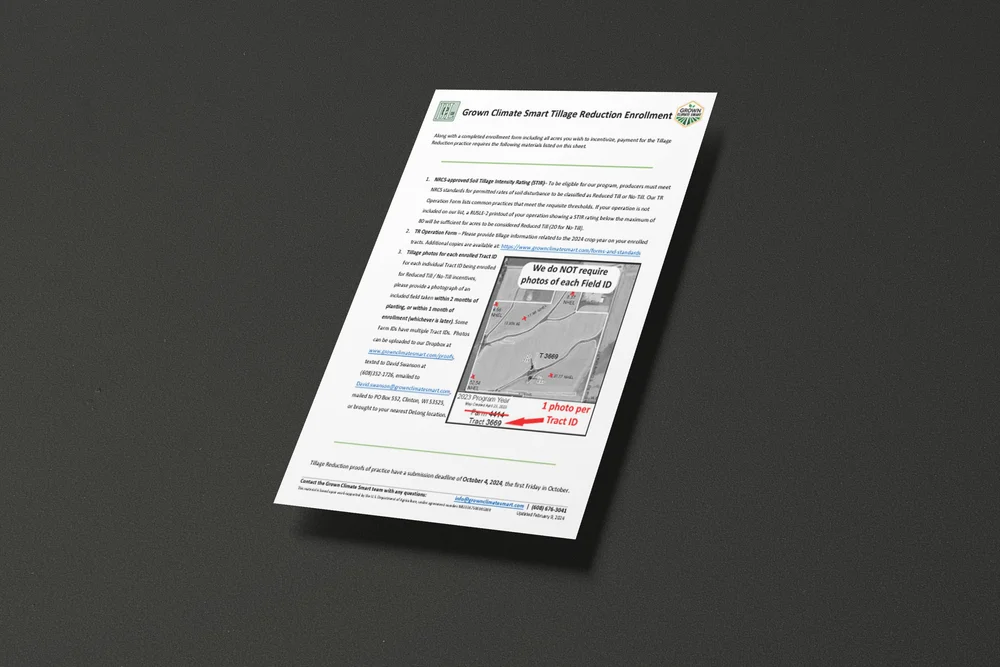
- NRCS-approved Soil Tillage Intensity Rating (STIR) — To be eligible for our program, producers must meet NRCS standards for permitted rates of soil disturbance to be classified as Reduced Till. Below is a list of common practices that meet the requisite thresholds. If your operation is not included on our list, a RUSLE-2 printout of your operation showing a STIR rating below the maximum of 80 will be sufficient for acres to be considered Reduced Till. If your enrollment requires changes, enter your tillage type (or the accompanying Tillage ID letter) in the "Tillage Type" column of each line.
Tillage Operation Tillage ID No-till – No soil disturbance except for planting A Strip-till – No soil disturbance except for 30% of the surface at planting with a strip-till planter. NRCS considers Strip-Till operations eligible as No-Till B Fall Vertical Tillage – Fall pass plus a spring pass with same seedbed conditioner: double gang coulter caddy, rotary harrow, and rolling basket incorporator C Spring Vertical Tillage – Spring pass using a seedbed conditioner with a double gang coulter caddy, rotary harrow, and rolling basket incorporator D Fall field cultivation – Fall field cultivation & light finishing in spring E Spring field cultivation – One field cultivation before planting, applies to most 1-pass systems F Disk Ripper – Subsoil ripper with tandem disk gangs in front and leveling disks behind G Tillage Practices NOT accepted: Chisel Plow + Disk Ripper | Moldboard Plow
Tillage practices accepted with a RUSLE2 printout showing a STIR rating lower than 80: Chisel Plow with no Disk | any tillage operations not included above
- Tillage photos for each enrolled Tract ID — For each individual Tract ID being enrolled for Reduced Till / No-Till incentives, please provide a photograph of an included field taken within 2 months of planting, or within 1 month of enrollment (whichever is later). Some Farm IDs have multiple Tract IDs. Photos can be uploaded to our Dropbox at grownclimatesmart.com/proofs, texted to David Swanson at (608) 352-1726, emailed to David.swanson@grownclimatesmart.com, mailed to PO Box 552, Clinton, WI 53525, or brought to your nearest DeLong location.
Tillage Reduction proofs of practice have a submission deadline of August 7, 2026 - the first Friday in August.
Nutrient Management Plan Proof of Practice Guide
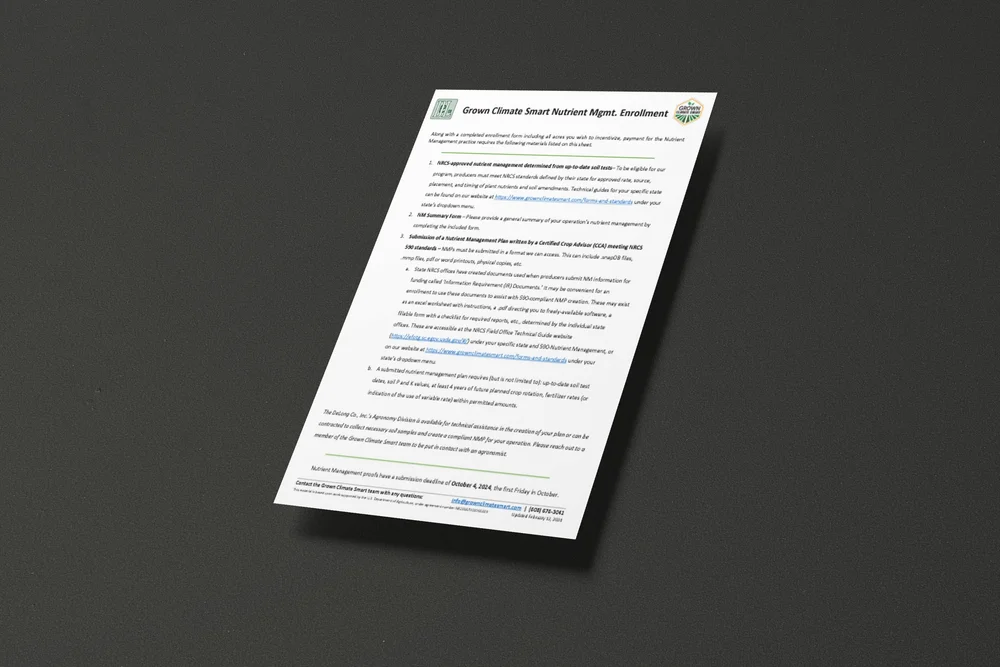
Along with a completed enrollment form including all acres you wish to incentivize, payment for the Nutrient Management practice requires the following materials listed on this sheet:
- Submission of a Nutrient Management Plan written by a Certified Crop Advisor (CCA) meeting NRCS 590 standards — NMPs must be submitted in a format we can access. This can include .snapDB files, .mmp files, pdf or word printouts, physical copies, etc.
- Technical guides for your specific state's NRCS standards can be found on our website at grownclimatesmart.com/forms-and-standards under your state's dropdown menu. State NRCS offices have created documents used when producers submit NM information for funding called 'Information Requirement (IR) Documents.' It may be convenient for an enrollment to use these documents to assist with 590-compliant NMP creation. These may exist as an excel worksheet with instructions, a .pdf directing you to freely-available software, a fillable form with a checklist for required reports, etc., determined by the individual state offices.
- Nutrient Management (CPS 590) practice standard computations and analyses to develop plans and specifications include, but are not limited to:
- Results of all available tests provided by the producer upon which the nutrient budget and management plan will be based.
- Current and planned plant production sequence or crop rotation. Realistic yield goals for the crops (where applicable for developing the nutrient management plan).
- RUSLE2 soil erosion calculations for the site
- Phosphorus Calculations approved by your state.
- Site-specific risk assessment tool results for nitrogen loss
- Nutrient recommendations for N, P, and potassium (K) for the entire plant production sequence or crop rotation.
- Written plans and specifications include:
- Maps that identify areas on which nutrients will be applied.
- Location of designated sensitive areas and the associated nutrient application restrictions and setbacks.
- Listing, quantification, application method, and timing for all nutrient sources (including all enhanced efficiency fertilizer products) that are planned for use and documentation of all nutrient imports, exports, and onsite transfers.
- Other requirements listed in the NRCS Conservation Practice Standard Nutrient Management (Code 590).
- NM Summary Form — Please provide a general summary of your operation's nutrient management by completing the included form.
The DeLong Co., Inc.'s Agronomy Division is available for technical assistance in the creation of your plan or can be contracted to collect necessary soil samples and create a compliant NMP for your operation. Please reach out to a member of the Grown Climate Smart team to be put in contact with an agronomist.
Nutrient Management proofs have a submission deadline of December 31, 2026.
Illinois Nutrient Management Guidance
This sheet provides information and guidance on creation of a 590-compliant nutrient management plan for Illinois enrollments. All plans must be created by a Certified Crop Advisor (CCA) to meet the Illinois NRCS's 590 standards. These are found at efotg.sc.egov.usda.gov or can be requested from the Grown Climate Smart team.
Nutrient Management (CPS 590) practice standard computations and analyses to develop plans and specifications include, but are not limited to:
- Results of all available tests provided by the producer upon which the nutrient budget and management plan will be based.
- Current and planned plant production sequence or crop rotation, and realistic yield goals for the crops (where applicable).
- RUSLE2 soil erosion calculations for the site.
- Illinois Phosphorus Index calculation.
- Site-specific risk assessment tool results for nitrogen loss.
- Nutrient recommendations for N, P, and potassium (K) for the entire plant production sequence or crop rotation.
Written plans and specifications include:
- Maps that identify areas on which nutrients will be applied.
- Location of designated sensitive areas and the associated nutrient application restrictions and setbacks.
- Listing, quantification, application method, and timing for all nutrient sources (including enhanced efficiency fertilizer products) that are planned for use and documentation of all nutrient imports, exports, and onsite transfers.
- Other requirements listed in the NRCS Conservation Practice Standard Nutrient Management (Code 590).
Plan Creation — MyFarms has partnered with Purdue University and the Natural Resources Conservation Service (NRCS) to bring improved versions of their Manure Management Planner (MMP), which remains publicly available and free-of-charge. The Grown Climate Smart team suggests Illinois Nutrient Management enrollments use this software in the creation of an NMP. Once field information is uploaded, calculations for N, P, and soil loss can be made and rotational information can be entered. This can be downloaded from purduemmp.myfarms.com.
Nutrient Management proofs have a submission deadline of December 31, 2026.
In the field right now? Take a photo, add your FSA Tract ID, and submit.
How To Put Tract ID Numbers on Photos
Two quick resources you can use right now. Choose the illustrated infographic with written steps, or jump to the simplified picture-only form.